
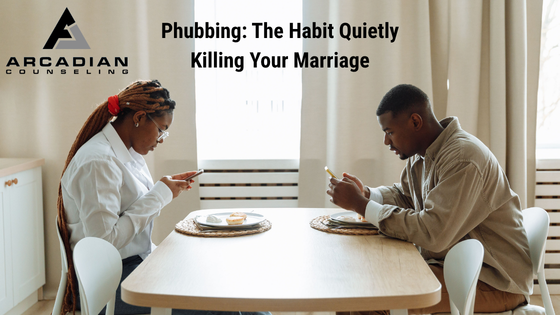
There’s a word for something you’ve almost certainly done to your wife this week, and probably something she’s done to you too, and until researchers gave it a name most of us never even registered it as a real behavior worth examining.
It’s called phubbing, a mashup of “phone” and “snubbing,” and it means exactly what it sounds like. Ignoring the person in front of you in favor of your phone. Glancing down mid-conversation. Half-listening while scrolling. Being physically present and functionally absent, over and over, in tiny moments that never feel significant enough on their own to bring up, but that quietly accumulate into something that eventually does feel significant, usually right around the time one of you says the marriage feels lonely and neither of you can quite explain why.
Let’s talk about phubbing specifically, not as a vague “we’re all on our phones too much” observation, but as an actual studied phenomenon with real, measurable effects on relationship satisfaction, because I see the consequences of it constantly in my office, and almost nobody walks in and names it directly. They name the downstream consequences: feelings of loneliness and disconnection.
A sense that something is off even though nothing dramatic has happened. Phubbing is very often the quiet mechanism underneath that feeling, and it does its damage precisely because each individual instance seems too small to matter.
The Research Behind Something You Already Feel

Researchers who study phubbing have found it’s associated with lower relationship satisfaction, increased conflict, and in some studies, higher rates of depression in the partner being phubbed. That last part is worth sitting with. This isn’t just an annoyance.
Being consistently phubbed by someone you’re emotionally invested in appears to actually affect mood and mental health over time, which makes sense once you think about what’s actually happening underneath the behavior. When your partner glances at their phone instead of staying with you in a moment, you’re getting a small, repeated signal that you’re less interesting, less important, less worth their attention than whatever’s on that screen.
Nobody says that out loud. Nobody consciously intends to send that message. But the nervous system on the receiving end doesn’t need it said out loud to register it.
And here’s the part that makes phubbing especially insidious compared to more obvious relationship problems. There’s no argument to point to. No specific event either of you can name as the moment things started feeling off.
It’s death by a thousand small absences, and because none of them look like anything on their own, couples often go years without correctly identifying what’s actually eroding the connection between them.
What Phubbing Actually Looks Like at Home
Let’s get specific because the vague version of this, “we should put our phones down more,” never actually changes anyone’s behavior.
Phubbing looks like checking your phone during dinner while your wife is telling you about her day.
It looks like glancing at a notification mid-sentence while your kid is showing you something they’re proud of, and your spouse watching that happen from across the room.
It looks like lying in bed next to each other, both scrolling, technically together and completely alone at the same time, which might be the most quietly devastating version of it, because it’s mistaken for closeness when it’s actually its opposite.
It also looks like being the one doing the phubbing while telling yourself a story that makes it feel okay. I just need to check one thing. It’s work, it’s important. She’s on her phone too, so it’s not like I’m the only one. I’ll pay attention in a second. Every one of these is a small negotiation with yourself.
This Isn’t About Blame, It’s About Both People Owning Their Part
It would be easy to write this as a piece about one partner’s phone habit ruining a marriage, but that’s rarely the honest, complete picture. In most marriages I see, phubbing runs in both directions. Both people are doing it to some degree, both people are on the receiving end of it, and both people are probably telling themselves a version of the same justifying story.
The point isn’t to figure out who’s worse, who started it, who deserves the apology first. The point is recognizing that you’re a participant in this pattern, not just a victim of your spouse’s phone habit, even in moments where it genuinely feels like the imbalance runs heavily one direction.
Owning your own contribution, even a smaller one, is usually what actually gets a couple unstuck, because pointing exclusively at the other person’s behavior rarely produces change, it just produces defensiveness.
What Actually Helps

Small, specific, protected windows of undistracted attention do more to counteract phubbing than any sweeping resolution to “use your phone less” ever will. A resolution that vague doesn’t survive first contact with a busy week. Specificity does.
Pick one meal a day, phones in another room entirely, not face down on the table, actually out of the space.
When your spouse is telling you something, even something that seems small or mundane, put the phone down fully before responding, not glancing up while still holding it. That physical gesture, setting it down completely, registers on some level even if neither of you consciously names it.
Notice your own phubbing before you notice your spouse’s. It’s always easier to spot in someone else. Catching yourself mid-reach and choosing differently is worth more than any conversation you could have about your partner’s habits.
Have an actual conversation about this, using the word if it helps, phubbing, because naming a pattern accurately makes it far easier to interrupt than continuing to experience it as a vague, unnamed feeling of distance that neither of you can quite locate the source of.
The Real Cost
Marriages don’t usually end because of one dramatic betrayal in the majority of cases. They erode slowly, through thousands of small moments where one person needed the other to be present and got a version of them that was split, half here and half somewhere else entirely.
Phubbing is one of the clearest, most common examples of that slow erosion, precisely because it’s so easy to dismiss as harmless. It rarely feels like betrayal in the moment. It just feels like checking your phone. But add it up over months and years, and it becomes one of the quieter ways two people who love each other end up feeling like strangers sharing a house.
You don’t need to overhaul your entire relationship with technology to change this. You need a handful of genuinely protected moments where the phone isn’t just silenced but absent, and the person in front of you gets all of you instead of most of you.
That’s a small thing to build. It’s also, more often than people expect, exactly the thing that starts closing the distance.
James Killian, LPC is a Licensed Professional Counselor and the founder of Arcadian Counseling in Connecticut. He works with professional men navigating anxiety, relationships, fatherhood, and high-pressure careers. His approach is direct, grounded, and focused on helping clients regain steadiness and self-respect during demanding stages of life while blending psychological insight with real-world experience to support men in reclaiming clarity, strength, and purpose.