
Most dads don’t intend to be harder on their kids than they mean to be. It just happens. You snap. Your tone goes flat and sharp at the same time. What should have been a small correction comes out with way more juice than the moment called for, and later, when the house is quiet and you’re sitting there at 10pm, you feel it land. The regret. The replay. The same question you’ve asked yourself a hundred times.
Why did I react like that?
If you’re harder on your kids than you want to be, it’s almost never that you don’t love them enough. It’s that something in you is overloaded, unresolved, or getting hit faster than you can catch it. And if you misread the problem, you keep trying to fix it at the wrong level. You tell yourself to be more patient next time. More calm. More disciplined. Then the moment shows up again and you react from the same exact place. Because the place hasn’t changed. Only the resolution did.
So let’s talk about what’s underneath
The thing you’re reacting to is rarely just the thing in front of you. Your son is moving slow when you’re already running late. Your kid is not listening after you’ve said it three times. He’s careless with something you just told him mattered. He’s distracted, emotional, mouthy, lazy, soft, whatever the word is in your head.
And yes, that’s frustrating.
But the size of your reaction usually isn’t coming from the moment. It’s coming from everything stacked behind it. The work week. The bills. The marriage that’s been a little quiet lately. The fact that you slept like shit. The pressure of feeling like the whole damn ship is riding on you and nobody can really see how heavy it is.
And sometimes you’re not even reacting to your kid. You’re reacting to what their behavior means to you.
A kid being distracted can light up a father’s fear that he’s failing to prepare him. A kid being passive can poke at a dad’s anxiety about weakness, especially in his sons. A kid getting emotionally overwhelmed can irritate the hell out of a father who never had room for his own emotions and still doesn’t know what to do with them when they show up in someone else. A kid not taking correction well can trigger something old in a man who got punished or shamed for a lot less when he was that age.
In these moments you’re not just correcting behavior. You’re reacting from your nervous system, your beliefs, your history, your pressure, all of it firing in the half second before you open your mouth. That’s why some reactions feel bigger than they should.
It’s not just what your kid did. It’s what got touched in you when he did it.
A lot of fathers are walking around carrying more than they realize. Low-grade tension that never fully shuts off. Work, money, marriage, time, the mental load of keeping the whole operation running, the quiet pressure of wanting to be a good father and not really knowing if you are.
That kind of strain narrows your margin. And when your margin gets thin, normal kid behavior stops feeling normal. It feels louder. More personal. More intolerable. That doesn’t excuse the reaction. It explains a piece of it. A father who’s already mentally cooked reacts differently than a father with internal space. Same kid, same behavior, different dad in that chair.
There’s another piece people don’t want to look at. Some fathers get hard because they believe hardness is what prepares a kid for life. They don’t want their boys soft, entitled, fragile, unable to handle discomfort. So they tighten up. They push harder. They bring more force into the moment than the moment actually needs.
And underneath that is fear. Fear that if I’m too soft, he won’t be ready. Fear that if I let this slide, it becomes a pattern. Fear that kindness gets read as weakness. But fear-based parenting almost always runs too hot. You might get the short-term compliance. You usually pay for it in closeness. And what you’re really teaching your kid is to fear your intensity more than understand your message.
That’s not strength. That’s pressure leaking downhill.
You already know what this looks like
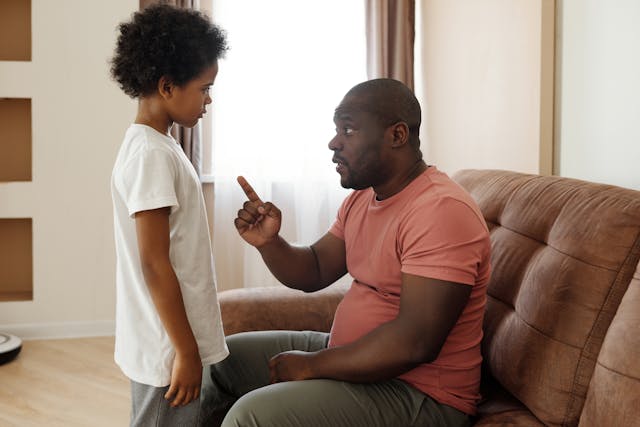
A father comes home mentally cooked, his son ignores a simple instruction, and a normal correction comes out three notches too loud. A dad watches his kid get discouraged fast and instead of helping him settle, he gets frustrated, not because he wants to hurt him, but because the overwhelm stirs something in him he doesn’t have a way to tolerate. A dad at practice hears his son making excuses, and the edge in his voice has way more in it than the situation called for.
Underneath isn’t just frustration. It’s fear, identity, pressure, the need to feel like he’s helping shape his son into someone capable. That’s why the regret hits afterward. Some part of him knows the reaction was too much, even if the issue itself was real.
So what do you do with the regret?
Most decent dads feel bad afterward. That guilt matters. It tells you your conscience is working. But guilt by itself doesn’t change much. Sometimes it makes things worse, because you feel bad, promise yourself you’ll do better, then try to white-knuckle more patience the next time.
That never holds.
If you want to actually change the pattern, you have to understand the pattern. What situations pull the hardest on you? What kinds of behavior trigger the biggest reaction? What’s the story running in your head in those moments? What are you afraid their behavior means about them, or about you? That’s where the work is. Not in the apology. In the noticing.
A few things actually help
Catch your escalation earlier. Not after you snapped. Before. The tightening jaw. The clipped breath. The feeling that this needs to stop right now. That moment, the one before the reaction, is the only place change actually lives.
Separate the behavior from the meaning your mind slaps on it. Your kid forgetting something doesn’t mean he’s irresponsible. Your kid getting emotional doesn’t mean he’s weak. Your kid resisting you doesn’t mean you’re losing him.
The story you’re telling yourself in the heat of the moment is almost never the most accurate read.
It’s just the loudest one.
Deal with your own state
A lot of dads keep trying to improve their reactions without dealing with the fact that they’re chronically overloaded. Less sleep, more stress, no real downtime, no honest conversation with their wife in months. Then they wonder why they’re reactive. Your parenting is affected by the condition of your nervous system whether you like it or not. You don’t get to opt out of that math.
Repair faster

If you were too hard, own it. Don’t turn it into a speech about how much you love him. Just own it clean. I was too hard on you there. My tone was off. You needed correction but not like that. Repair doesn’t weaken your authority – it builds trust. Kids can handle a father who gets it wrong sometimes. What erodes them is a father who pretends he didn’t.
Get clearer on what kind of father you actually want to be. Not vague values. Specific ones. Calm under pressure. Firm without humiliating. Honest without contempt. Strong without making him feel small. If you don’t define that for yourself, stress will define it for you, and stress always picks the worst version.
Your kid does need correction
He just doesn’t need your overflow. None of this is a pitch for permissiveness. Kids need limits. They need firmness. They need parents who can tolerate being the adult in the room when nobody else wants the job. But they don’t need your accumulated frustration from work, money, marriage, and exhaustion poured into a correction about cleats on the kitchen floor. They need steadiness more than force.
The goal isn’t no standards. It’s cleaner standards. Correction that comes from clarity, not from spillover.
Therapy and coaching can help when you keep having the same reaction and you can’t figure out why it keeps happening. The issue is usually deeper than anger. It’s stress, history, perfectionism, fear, a nervous system stretched too thin for too long.
A good therapist helps you see what’s getting activated, what beliefs are running underneath the intensity, and what kind of father you become when you’re under strain. From there the work gets practical. You learn to catch escalation sooner. Regulate faster. Separate your kid’s behavior from your own history. Stay firm without going harsh. Repair when you miss it.
That’s real work, and it matters, because most fathers I sit with don’t want to stop caring. They want to stop letting pressure distort how that care comes through.
Here’s the bottom line.
If you’re harder on your kids than you want to be, the issue is almost never that you’re a bad parent. It’s that something in you is getting activated faster than you can catch it. Stress. Fear. Pressure. Old wiring. Thin margin. Unresolved emotion. Your kid’s behavior may be real. The need for correction may be real. And your reaction can still be bigger than it needs to be. That’s the part worth paying attention to. Because your kids don’t need a perfect father. They need one who’s willing to look at what’s coming out of him, take responsibility for it, and work to make it cleaner over time.
That’s the work. And it’s the work most of us never got modeled, which is why most of us are figuring it out on the fly.
Welcome to the club.
James Killian, LPC is a Licensed Professional Counselor and the founder of Arcadian Counseling in Connecticut. He works with professional men navigating anxiety, relationships, fatherhood, and high-pressure careers. His approach is direct, grounded, and focused on helping clients regain steadiness and self-respect during demanding stages of life while blending psychological insight with real-world experience to support men in reclaiming clarity, strength, and purpose.