
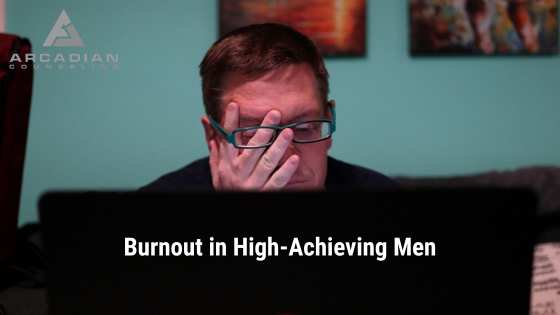
I’ve sat across from hundreds of successful men over the years. Founders. Surgeons. Sales executives. Guys running teams of fifty people who can’t remember the last time they took a full weekend off. And almost every single one of them walks into my office saying some version of the same thing: “I don’t know why I feel this way. I have everything I’m supposed to want.”
That sentence right there is the whole problem.
Burnout in high-achieving men doesn’t look like the burnout you see in stock photos. It’s not a guy collapsed at his desk. It’s a guy who is still closing deals, still hitting numbers, still showing up to his kid’s baseball game on time, and still feels completely hollowed out on the inside. High-achievers are really, really good at performing competence right up until the moment they can’t anymore. That’s what makes this so dangerous. The mask holds for years. And then one day it doesn’t.
Why High Performers Burn Out Differently
Most burnout advice is written for people who are already showing obvious signs of struggle. Missed deadlines. Visible anxiety. Trouble functioning. That’s not who I’m talking to.
The men I work with are the opposite. They’re overfunctioning. And overfunctioning is exactly what makes their burnout so hard to catch, both for the people around them and for themselves.
A few patterns I see constantly with burnout in high-achieving men:
- Identity fusion with performance. Somewhere along the way, “what I do” became “who I am.” When your entire sense of worth is tied to output, rest starts to feel like a threat instead of a need.
- Emotional outsourcing. These men are experts at managing everyone else’s problems, at work and at home, while quietly ignoring their own internal state. They’ll notice a struggling employee before they notice they haven’t felt joy in six months.
- The “I can handle it” trap. Capability becomes a prison. The better you are at pushing through, the longer you’ll push through something that should have stopped you months ago.
- Numbing instead of noticing. Alcohol, overworking, scrolling, obsessive fitness routines. Not always destructive on their own, but often used as a way to avoid sitting still with what’s actually going on underneath.
None of this is weakness. It’s usually the exact same drive and discipline that made these men successful in the first place, just pointed at the wrong target for too long.
What Burnout Actually Feels Like (Not What You Think)

Forget the checklist version of burnout for a second. Here’s what it actually sounds like in session:
- “I used to love this job. Now I just feel numb doing it.”
- “I get irritated with my kids over nothing and I hate that about myself.”
- “I keep waiting to feel like things are enough, and they never do.”
- “I’m successful by every metric that matters and I still feel like I’m failing somehow.”
- “I don’t know when I stopped feeling anything.”
That last one comes up more than people realize. Burnout in high-achieving men often isn’t loud. It’s flat. It’s the slow erosion of feeling anything at all, good or bad, because staying numb is easier than confronting what’s underneath.
The Cost Nobody Talks About
Here’s the part that doesn’t get said enough. Burnout doesn’t just cost you at work. It costs you at home, in ways that are much harder to reverse.
The men I see aren’t neglecting their families on purpose. They’re present physically and depleted emotionally. They show up to the game, but they’re checked out watching it. They answer their kid’s question but miss the follow-up because their mind is still on the email from three hours ago. Over time, that gap between physical presence and emotional presence becomes its own kind of loneliness, both for them and for the people who love them.
And because these men are usually still functioning at a high level everywhere else, nobody around them thinks to ask if they’re okay. Why would they? The house looks fine from the outside.
What Actually Helps

I’m not going to give you a five step morning routine. If that worked, you’d have already found it. What actually moves the needle for the men I work with tends to be less about optimization and more about honesty.
- Separate your worth from your output. This is slow work, not a mindset switch. It usually starts with noticing how often you measure your value in a day by what you accomplished versus who you were.
- Get honest about what you’re avoiding. Numbing behaviors, whether it’s work itself or something else, are almost always pointing at something you don’t want to feel. The goal isn’t to white-knuckle your way out of the behavior. It’s to get curious about what it’s protecting you from.
- Rebuild a relationship with rest. Not rest as a reward you earn after enough output. Rest as a baseline requirement for being a functioning human being.
- Let someone see the real version of you. A therapist, a close friend, your spouse. Burnout in high-achieving men thrives in isolation. The performance of having it together is exhausting to maintain and it keeps you from getting the support that could actually help.
- Redefine what success has to include. Not instead of ambition. Alongside it. Success that costs you your marriage, your health, or your relationship with your kids isn’t success. It’s a trade you didn’t realize you were making.
The Real Question
If you’re reading this and something in it landed a little too close to home, here’s the question worth sitting with. Not “how do I get more done.” Not “how do I push through this.”
The question is: what would it actually take for you to feel like yourself again, not just perform like yourself?
That’s usually where the real work starts.
James Killian, LPC is the owner of Arcadian Counseling, a private practice in Greater New Haven, CT, specializing in helping over-thinkers, high achievers, and perfectionists reduce stress, increase fulfillment, and enhance performance — so they can move From Surviving to Thriving. He primarily works with professional men navigating high-pressure careers and meaningful life transitions. His approach blends psychological insight with real-world experience to support men in reclaiming clarity, strength, and purpose.