
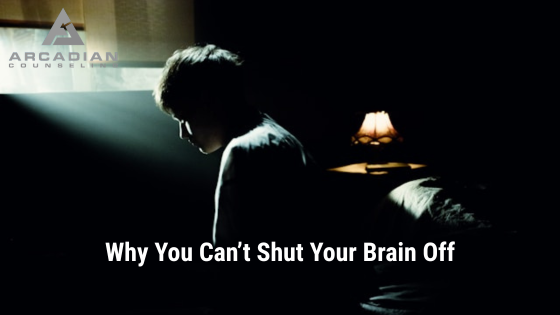
A lot of people describe it the same way. They’re exhausted, but still mentally running. They lie down and start thinking about work, money, marriage, kids, health, unfinished tasks, and conversations that are already over or haven’t happened yet. They want rest, but their mind keeps moving.
If you can’t shut your brain off, the issue is usually not that you simply think too much. The issue is that your mind has gotten stuck in work mode, problem-solving mode, or threat-monitoring mode, and it no longer knows when to stand down.
Understanding Why You Can’t Shut Your Brain Off
When you feel like you can’t shut your brain off, what’s happening is your mind is always scanning, planning, rehearsing, reviewing, or bracing.
That can look productive on the surface. It can even feel responsible. But over time, it becomes a strain on the whole system. You’re not just thinking. You’re staying mentally engaged long after the day is over.
That’s why when you can’t shut your brain off you often feel tired and wired at the same time. Your body wants sleep. Your mind is still trying to manage life.
Why it gets worse at night

This is one of the most common parts of the pattern.
During the day, there are distractions. Meetings, emails, errands, people, deadlines, and noise keep your attention occupied. At night, all of that drops away. The quiet does not create the problem. It exposes it.
If you can’t shut your brain off at night, it’s often because the pressure you pushed aside during the day now has room to surface. The mind starts catching up on what never got processed.
That’s why so many people can function all day and then suddenly feel mentally flooded once they get into bed.
What is usually underneath it
If you can’t shut your brain off, something is feeding the loop.
Sometimes it’s chronic pressure. You’ve been carrying too much for too long without enough real recovery.
Sometimes it’s unresolved emotion. Frustration, resentment, fear, or uncertainty that never gets addressed comes back as mental noise.
Sometimes it’s over-responsibility. Your mind has learned that staying mentally engaged feels safer than letting go.
And sometimes it’s avoidance. If you don’t want to feel something, your brain stays busy so you don’t have to sit still long enough to actually face it.
That matters. Because if you can’t shut your brain off, the answer isn’t always more relaxation.
The answer is dealing with what your mind keeps circling.
What this looks like in real life
You get into bed and start running through tomorrow’s schedule. That turns into thinking about a conversation with your boss, then your finances, then whether you’ve been distracted with his kids, then whether your marriage feels off. By the time you notice what’s happening, you’re wide awake.
You finally have downtime, but instead of relaxing, you start replaying an argument and building better responses in your head.
You sit on the couch at the end of the night, physically still but mentally pacing.
This is what it looks like when you can’t shut your brain off. Not collapse. Not chaos. Just constant background mental work that never really ends.
Why trying to force relaxation backfires

A lot of people respond to this by telling themselves to calm down, stop thinking, or just relax.
If only it were that simple.
If you can’t shut your brain off, forcing yourself to think less is often like trying to shut off a car by yelling at the dashboard. The issue isn
The issue isn’t a lack of effort. The issue is your system has learned to stay activated.
For many people, stillness feels unfamiliar. It means less distraction, less control, and more contact with what’s actually bothering us. So the mind keeps moving because movement feels safer than stopping.
This is why people who can’t shut their brain off often need more than just sleep hygiene strategies. They need to understand why their mind is working this hard in the first place.
The cost of staying this way
If you can’t shut your brain off, the cost spreads fast.
Sleep gets worse. Patience gets thinner. You become more irritable, less present, and harder to reach. Even when you are home, part of you is still elsewhere, running background calculations.
That affects work, marriage, fatherhood, and your ability to feel settled in your own life. A lot of people who can’t shut your brain off start feeling like they are always on, but never fully here.
What helps When You Can’t Shut Your Brain Off
First, stop treating this like a character flaw. If you can’t shut your brain off, it doesn’t mean you’re weak or broken. It usually means there’s a pattern that needs to be understood.
Second, get specific about what your mind is carrying. What is unfinished? What are you avoiding? What decision is still sitting in limbo? What conversation needs to happen? A busy mind usually has specific fuel.
Third, get things out of your head before the day ends. Write down tomorrow’s tasks. Capture loose ends. Decide what can wait. If you can’t shut your brain off, it helps when your brain no longer has to act like a storage unit.
Fourth, build an actual transition between work and home. A walk, a workout, ten quiet minutes in the car, a shower without your phone. Something that tells your system the day is changing.
Fifth, take action where action is needed. If your mind keeps circling the same issue, more thinking may not be the answer. The answer may be to have the conversation, review the numbers, make the appointment, set the boundary, or make the decision.
The Bottom Line
If you can’t shut your brain off, your mind has probably learned that staying active is how you stay ahead, stay useful, or stay safe.
That may have worked for a while. But if you can’t shut your brain off now, the cost is probably showing up in your sleep, your mood, your relationships, and your ability to be present.
The answer isn’t to force yourself to relax harder. It’s to understand what your mind is carrying, what it is protecting you from, and what needs to change so you no longer feel like you have to stay mentally on all the time.
James Killian, LPC is a Licensed Professional Counselor and the founder of Arcadian Counseling in Connecticut. He works with professional men navigating anxiety, relationships, fatherhood, and high-pressure careers. His approach is direct, grounded, and focused on helping clients regain steadiness and self-respect during demanding stages of life while blending psychological insight with real-world experience to support men in reclaiming clarity, strength, and purpose.