
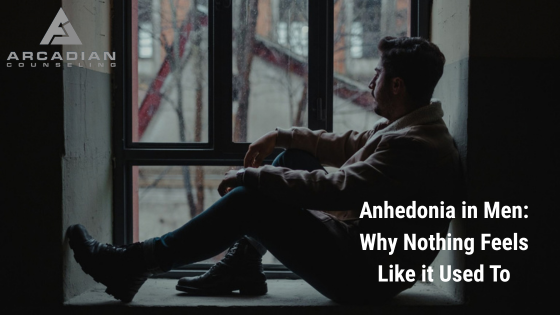
Your kid hits a double in the gap and the whole bleacher erupts. You clap, you smile, you say the right thing on the ride home. And somewhere under all of it, you feel almost nothing. You used to love this. You used to count down to Saturdays like this. Now you’re watching it happen from a few feet away, and then you feel guilty for not feeling more. That experience has a name. It’s called anhedonia, and anhedonia in men is one of the most common and least recognized signs that something is wrong, because it doesn’t look like sadness. It looks like a man who has simply stopped enjoying his life.
What Anhedonia in Men Actually Means
Anhedonia is the loss of the ability to feel pleasure or interest in things that used to bring it. It isn’t sadness. It’s more like the volume being turned down on everything good.
Food tastes fine but doesn’t satisfy. A win at work lands as relief that it’s over, not as satisfaction. Time with friends feels like an obligation you’re getting through. The hobby that used to absorb you for hours now sits untouched, and you can’t remember when you stopped.
It’s a recognized symptom of depression, and it can also show up with chronic stress, burnout and other conditions. The important part is this: you’re not ungrateful, lazy or broken. Something in how your brain registers reward has gone quiet.
Why Anhedonia in Men Gets Missed
Men tend to explain it away. You tell yourself you’re tired, or getting older, or burned out, or that this is just what adult life feels like after forty. Everyone around you is in the same fog, so it passes as normal.
It also hides behind functioning. If you’re still working, still providing, still showing up to the games and the dinners, nobody has a reason to ask. Anhedonia in men often goes unnoticed for years because the obligations keep getting met while the enjoyment quietly drains out.
And then there’s the shame. A man with a good job, a family and a decent life is supposed to be grateful. So when he can’t feel it, he assumes the problem is his character, not his health. Most men never say it out loud. They just stop expecting to feel good.
What It Looks Like Day to Day
It rarely shows up as one dramatic change. More often it’s a slow subtraction:
- The things you did for yourself went first. The gym, the guys, golf, music, the project in the garage.
- Weekends feel like a task list to get through rather than time to enjoy.
- You say yes to plans out of duty and feel nothing once you’re there.
- Good news barely registers. Bad news doesn’t register much either.
- You’re more irritable, because when nothing feels rewarding, small frustrations loom larger.
- You push harder at work because it’s the only place you still feel anything, even if that feeling is just pressure.
- Sex, food, a drink, a game or a screen stop doing what they used to, so you need more to feel less.
If most of this sounds familiar, you may be dealing with anhedonia in men in its most common form: a life that looks fine and feels flat. (It often travels with high-functioning depression in men, which goes deeper on how that pattern builds.)
The Part Nobody Mentions: The Guilt
For a husband and father, anhedonia carries a particular weight. You’re at the recital, the game, the birthday dinner, and you can’t feel what you know you’re supposed to feel. So you perform it. Smile on cue, say the right thing, keep the moment looking right.
Then the guilt kicks in. Your kids deserve a dad who’s fully there. Your wife deserves a husband who laughs again. And you think, what kind of man can’t enjoy his own family?
That guilt deepens the problem. It adds shame on top of numbness, and men who feel ashamed of a symptom are much less likely to get help for it.
Why “Just Do More Things You Enjoy” Doesn’t Work
The standard advice is to schedule fun and push through. It sounds reasonable, and it’s partly right, but it misses something. When the reward system is muted, pleasure isn’t available on demand. Forcing yourself through activities that feel empty can leave you feeling like you’re failing at fun, which makes it worse.
What tends to work is smaller and slower. You rebuild the connection to enjoyment in steps, often starting with activity before pleasure rather than waiting for the feeling to arrive first.
What Helps
Start with your doctor. Anhedonia can have physical contributors, including thyroid problems, sleep disorders, low testosterone and certain medications. A medical check is a reasonable first step and doesn’t replace talking to someone about the rest.
Track what still gives you even a flicker. Maybe it’s a certain song, a drive, a hot shower, a conversation with one person. Small signals count, and they’re a place to build from.
Act first, expect the feeling later. Go for the walk or the workout or the game anyway, with no pressure to enjoy it. Repeated contact with things you used to like can slowly bring responsiveness back.
Tell one person the real version. “I haven’t been enjoying much lately” is a complete sentence. It cuts through a lot of the isolation.
Talk to a counselor. Therapy for anhedonia in men isn’t about forcing yourself to feel better. It’s about understanding what’s driving the numbness, whether that’s depression, chronic stress or long-term overwork, and rebuilding the pieces of your life that carry meaning. If you’re in Connecticut, this is work I do with men regularly.
If you’re having thoughts of hurting yourself or ending your life, please reach out right away. You can call or text 988, the Suicide & Crisis Lifeline, any time of day.
It Isn’t a Verdict on Your Life
Losing the ability to enjoy things feels like losing something permanent. It usually isn’t. Anhedonia in men is a symptom, and symptoms respond to the right kind of support. You don’t have to wait until you’ve lost interest in everything to ask for help. If nothing feels like it used to, that’s reason enough.
James Killian, LPC is a Licensed Professional Counselor and the founder of Arcadian Counseling in Connecticut. He works with professional men navigating anxiety, relationships, fatherhood, and high-pressure careers. His approach is direct, grounded, and focused on helping clients regain steadiness and self-respect during demanding stages of life while blending psychological insight with real-world experience to support men in reclaiming clarity, strength, and purpose.